AI Unwind, Hot CPI, and a Flight to Defensives
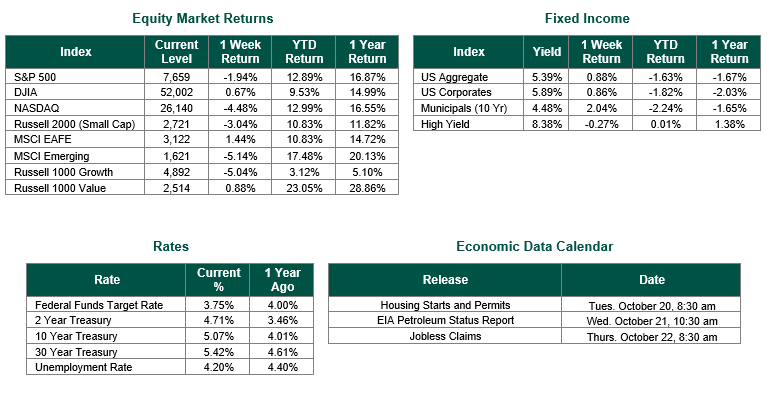
Global equity markets finished mixed for the week. In the U.S., the S&P 500 Index closed the week at a level of 7659, representing a decrease of 1.94%, while the Russell Midcap Index moved -1.19% last week. Meanwhile, the Russell 2000 Index, a measure of the Nation’s smallest publicly traded firms, returned -3.04% over the week. As developed international equity performance and emerging markets were mixed, returning +1.44% and -5.14%, respectively. Finally, the 10-year U.S. Treasury yield moved lower, closing the week at 5.07%.
Last week marked a decisive shift in the market’s tone, as a sharp sell-off in artificial intelligence-related stocks combined with a hotter-than-expected September inflation report and another surge in oil prices to produce the worst weekly performance for growth-oriented indexes since June. Beneath the index-level numbers, however, the story was far more nuanced than a simple risk-off week. Rotation into defensive and value-oriented sectors was pronounced, and the Dow Jones Industrial Average actually finished the week modestly higher despite meaningful weakness in technology and AI infrastructure names.
The dominant storyline was clearly the unwind in the AI complex. The Philadelphia Semiconductor Index declined roughly 11.4% on the week and posted its eighth consecutive down session, the longest such streak since October 2008. Concerns about the sustainability of the AI capital expenditure cycle, which had been building for weeks in the background, came to a head following a Financial Times report that OpenAI revenue was tracking below prior expectations and news that a Chinese memory manufacturer was closer to producing a denser DRAM cell architecture that could pressure the long-term supply dynamics underpinning memory stock valuations. The real catalyst, however, was the rapid widening in credit default swaps for CoreWeave, a prominent AI infrastructure provider. The broader concern is straightforward: the hyperscaler-led AI buildout has been financed increasingly through debt, and in a world where longer-dated Treasury yields are approaching their highest levels in more than two decades, the hurdle rate for new AI investment has risen materially. Whether the returns generated by AI services can justify the scale of infrastructure spending has quietly become the single most important question for the durability of the bull market.
The AI unwind was compounded by Wednesday’s September CPI report, which came in hotter than expected on both the headline and core measures. Headline CPI rose 0.6% month-over-month and accelerated to 3.7% year-over-year, up from 3.4% in August and above consensus for 3.6%. Core CPI rose 0.3% month-over-month and 2.6% year-over-year, both above expectations and well above the Fed’s 2% target. While a 9.1% monthly surge in gasoline prices accounted for over half of the headline increase, the broader picture was unambiguously firm, with shelter inflation reaccelerating to 3.2% and services inflation ticking higher as well. The market’s reaction was swift. According to CME FedWatch, the implied probability of a rate hike at the October 28 FOMC meeting jumped from roughly 22% the day before the release to 49% in the hours following, with markets now pricing in better than a 96% chance of at least one additional rate increase before year-end. Thursday’s slightly softer PPI print and a dovish set of comments from several Fed officials offered some relief, triggering a sharp intraday bond rally, but Friday’s close saw yields drift modestly higher again as attention turned to the implications for the FOMC’s late-October decision.
Looking to the week ahead, the calendar is relatively light on hard data, which puts the focus squarely on Q3 earnings and incoming Federal Reserve commentary ahead of the October 28 FOMC meeting. Several of the largest technology, financial, and industrial companies are scheduled to report results, and investor attention will be especially acute on commentary around AI-related capital spending plans, demand visibility, and financing considerations following last week’s sharp sell-off in the AI complex. On the data side, September housing starts, existing home sales, and preliminary S&P Global PMIs will offer additional texture on the state of the economy, and Federal Reserve commentary ahead of the pre-meeting blackout period will carry considerable weight given the newfound uncertainty around the October decision. Developments around the Middle East, oil prices, and any incremental progress on diplomatic efforts will also continue to drive day-to-day sentiment.
Best wishes to all for the week ahead!
Equity and Fixed Income Index returns sourced from Bloomberg on 10/16/26. CPI and PPI data was sourced from the Bureau of Labor Statistics on 10/14/26 and 10/15/26, respectively. Future interest rate probabilities are sourced from CME Group FedWatch. International developed markets are measured by the MSCI EAFE Index, emerging markets are measured by the MSCI EM Index, and U.S. Large Caps are defined by the S&P 500 Index. Sector performance is measured using the GICS methodology.
Disclosures: Past performance does not guarantee future results. We have taken this information from sources that we believe to be reliable and accurate. Hennion and Walsh cannot guarantee the accuracy of said information and cannot be held liable. You cannot invest directly in an index. Diversification can help mitigate the risk and volatility in your portfolio, but it does not ensure a profit or guarantee against a loss.