The Bond Market Takes the Wheel
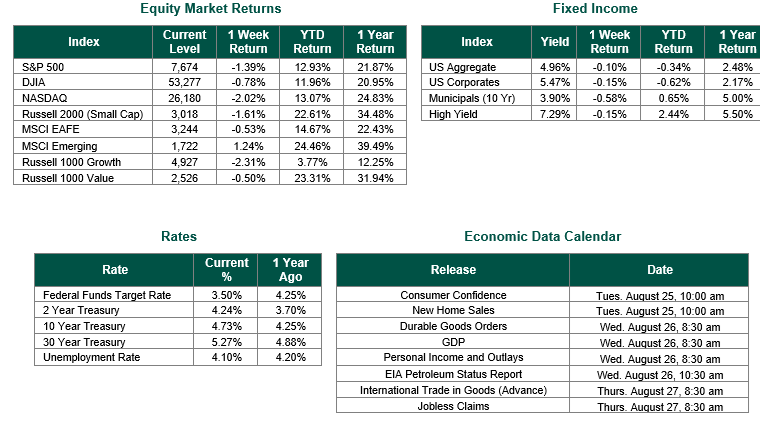
Global equity markets finished mixed for the week. In the U.S., the S&P 500 Index closed the week at a level of 7674, representing a decrease of 1.39%, while the Russell Midcap Index moved -1.23% last week. Meanwhile, the Russell 2000 Index, a measure of the Nation’s smallest publicly traded firms, returned -1.61% over the week. As developed international equity performance and emerging markets were mixed, returning -0.53% and +1.24%, respectively. Finally, the 10-year U.S. Treasury yield moved higher, closing the week at 4.73%.
Last week’s story was written in the Treasury market rather than the equity market. The 30 year U.S. Treasury yield reached 5.31% on Monday and topped 5.33% on Tuesday, a 19 year high, before settling at 5.27% on Friday. The 10 year climbed to 4.73% and the 2 year finished at 4.24%, so the entire curve shifted higher rather than steepening from the long end alone. No single data point explains the move. It reflects an accumulation of pressures: inflation above the Federal Reserve’s 2% target for more than five years, persistent federal deficits, a heavy calendar of long dated supply, and rising corporate borrowing tied to artificial intelligence infrastructure. Higher discount rates left little room for equities, and the S&P 500 surrendered the record high it had set a week earlier.
The Federal Reserve did nothing to soften that backdrop. Minutes from the July meeting, released Wednesday, showed the most dissents at a single meeting since 2014, and all three leaning the same way. The vote to hold the federal funds target at 3.50% to 3.75% was 9 to 3, with Beth Hammack, Neel Kashkari, and Lorie Logan each preferring an immediate quarter point increase. The minutes also noted that several participants favored a hike and that some questioned whether financial conditions were sufficiently restrictive to return inflation to 2%.
Friday’s activity data then made the hawkish case for them. The S&P Global flash composite output index for August jumped to 56.0, a 52 month high and the fastest pace of expansion since April 2022, against expectations closer to 54.0. Services led at 56.8 while manufacturing eased to 53.2, and the survey now points to third quarter growth approaching 3% annualized, roughly double the second quarter pace. When the open question is whether policy is tight enough, a reaccelerating economy is not the relief it would ordinarily be. Housing remained the exception, as July starts fell 12.4% to an annualized 1.24 million units, though permits rose 5.0%.
Retail earnings told a more nuanced story than the headline reactions suggested. Home Depot beat on both revenue and earnings Tuesday. Walmart raised its full year outlook Thursday and the shares still fell roughly 9%, as comparable sales of 2.6% fell short of the 3.8% Wall Street expected and the near term guide came in light. The company is also passing roughly $2.9 billion of tariff refunds back to shoppers, having delivered more than 11,000 price rollbacks in the quarter, trading near term margin for traffic and share. Target rose on a version of the same story. Beneath the index level, the rate move drove a sharp separation in style, with the Russell 1000 Growth Index falling 2.31% on the week against just 0.50% for the Russell 1000 Value Index, widening a year to date gap of 3.77% versus 23.31%. Gold gained nearly 5% on the week to a record near $4,600 per ounce and bitcoin posted its best week in more than two years.
The week ahead is dense. Consumer confidence and July new home sales arrive Tuesday. Wednesday carries durable goods orders, the revised second quarter GDP figure, and the July personal income and outlays report, where consensus looks for the core PCE price index to rise 0.2% for the month and hold at 3.3% year over year. A firmer print would put a September increase back into serious contention. Nvidia reports that afternoon, a result the market will read as a referendum on whether the artificial intelligence capital spending cycle can carry a higher cost of capital. The week then ends at Jackson Hole, where Chairman Warsh delivers his first keynote as Chair on Friday, less than three weeks before the September 15 and 16 policy meeting.
Best wishes to all for the week ahead!
Equity and Fixed Income Index returns sourced from Bloomberg on 8/21/26. FOMC minutes sourced from the Federal Reserve. Purchasing managers indices sourced from S&P Global. Housing starts and building permits sourced from the Census Bureau. International developed markets are measured by the MSCI EAFE Index, emerging markets are measured by the MSCI EM Index, and U.S. Large Caps are defined by the S&P 500 Index. Sector performance is measured using the GICS methodology.
Disclosures: Past performance does not guarantee future results. We have taken this information from sources that we believe to be reliable and accurate. Hennion and Walsh cannot guarantee the accuracy of said information and cannot be held liable. You cannot invest directly in an index. Diversification can help mitigate the risk and volatility in your portfolio but does not ensure a profit or guarantee against a loss.