Political Shift and AI Concerns Disrupt Markets
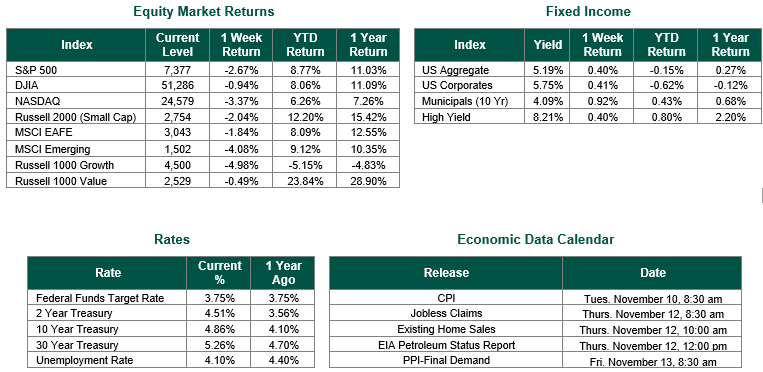
Global equity markets finished lower for the week. In the U.S., the S&P 500 Index closed the week at a level of 7377, representing a decrease of 2.67%, while the Russell Midcap Index moved -2.05% last week. Meanwhile, the Russell 2000 Index, a measure of the Nation’s smallest publicly traded firms, returned -2.04% over the week. As developed international equity performance and emerging markets were negative, returning -1.84% and -4.08%, respectively. Finally, the 10-year U.S. Treasury yield moved lower, closing the week at 4.86%.
Last week was defined by exceptional volatility, as a one-sided midterm election outcome, a renewed and sharp reassessment of artificial intelligence valuations, and a stronger-than-expected October jobs report combined to produce the worst weekly performance for major U.S. equity indexes since June. The arc of the week was unusually dramatic in which equities rallied on Wednesday on an initial relief response to the election outcome, were then hit by a brutal Thursday sell-off that sent the Nasdaq Composite into correction territory, and partially recovered on Friday as the labor market data provided some reassurance on the broader economic backdrop. Sector performance underscored the magnitude of the rotation: technology fell nearly 7% on the week, energy dropped roughly 12% alongside a sharp pullback in crude oil, and industrials came under meaningful pressure. In contrast, consumer discretionary, communication services, real estate, financials, and staples all finished the week higher as investors rotated into more defensive and rate-sensitive areas of the market.
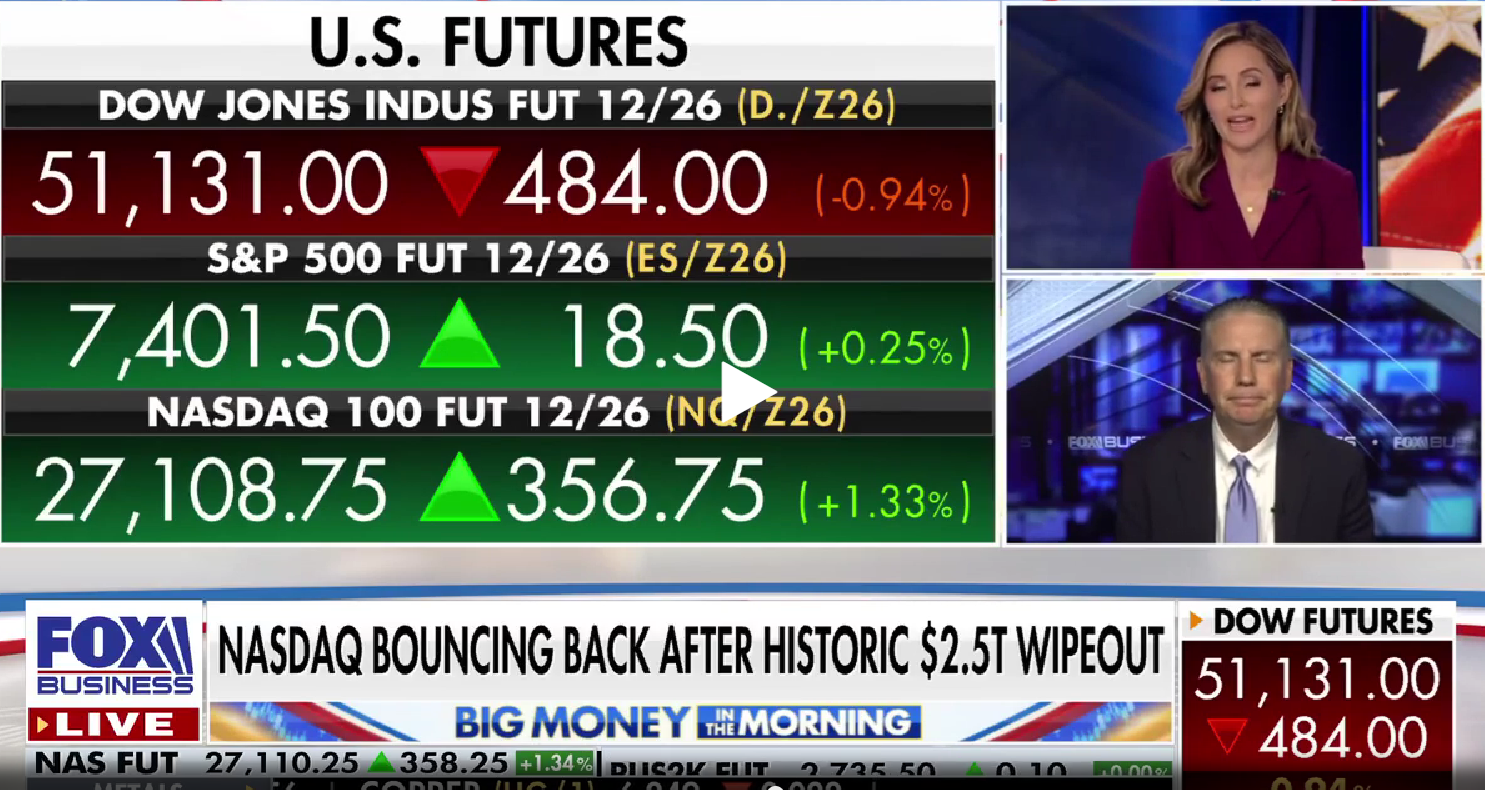
Thursday’s sell-off deserves particular attention given its scale and velocity. The Nasdaq Composite dropped 5.5% on the session, its largest single-day decline in nineteen months, and closed more than 10% below its October 6 record, formally entering correction territory. All eleven S&P 500 GICS sectors finished in the red, and mega-cap technology stocks that led the market for much of 2026 saw its combined market capitalization decline by more than $1 trillion in a single trading session. The VIX surged roughly 70% intraday to close near 28.2, its highest level since the summer, before easing modestly on Friday. The catalyst was a broad reassessment of AI investment sustainability, intensified by the election outcome, which raised concerns about the regulatory and policy outlook for large-cap technology companies.
The collapse in crude oil was equally notable. WTI crude fell nearly 13% on the week, pulling back sharply from the levels reached during the recent Middle East-driven rally and providing meaningful relief on the inflation front. The decline was driven by a combination of easing geopolitical tensions, better supply visibility, and the broader risk-off tone across global markets. The Treasury market continued to benefit from the softer growth tone and lower oil prices, with the 10-year yield falling for a fifth consecutive week to close at 4.86%, down from a peak above 5.30% in early October. The 2-year yield declined roughly 6 basis points on the week to 4.52% and has now fallen for six straight weeks, the longest such streak since September 2025. Friday’s October nonfarm payrolls report came in firmer than expected and offered some reassurance that the labor market, while cooling, remains durable enough to blunt recession concerns. That report, combined with hawkish commentary from two Fed officials earlier in the week, has left futures markets pricing in roughly a 75% probability of another rate hike at the December FOMC meeting, according to CME group.
Looking to the week ahead, the calendar is anchored by Thursday’s October Consumer Price Index release, which will be the single most important data point of the week and the last major inflation reading before the December FOMC meeting. Given the Fed’s heightened sensitivity to the inflation trajectory and the persistent back-and-forth in rate hike expectations, a hotter-than-expected print would likely reignite the move higher in yields and put further pressure on growth-oriented equities, while a cooler-than-expected reading would provide meaningful relief and extend the recent rally in Treasuries. October PPI on Friday, along with fresh retail sales and existing home sales data, will provide additional texture on the state of the economy. Third-quarter earnings season is winding down with roughly 440 of the S&P 500 companies having already reported, but a handful of consequential technology and semiconductor companies are on the calendar this week and will be closely watched following last week’s dramatic AI-related repricing.
In addition, on Veteran’s Day this upcoming week, we honor and express our deepest gratitude to those who have served in the armed forces. Best wishes to all for the week ahead!
Equity and Fixed Income Index returns sourced from Bloomberg on 11/6/26. Employment situation sourced from the Bureau of Labor Statistics on 11/6/26. Future interest rate probabilities are sourced from CME Group FedWatch. Midterm election returns are based on S&P 500 Index price data since 1950. International developed markets are measured by the MSCI EAFE Index, emerging markets are measured by the MSCI EM Index, and U.S. Large Caps are defined by the S&P 500 Index. Sector performance is measured using the GICS methodology.
Disclosures: Past performance does not guarantee future results. We have taken this information from sources that we believe to be reliable and accurate. Hennion and Walsh cannot guarantee the accuracy of said information and cannot be held liable. You cannot invest directly in an index. Diversification can help mitigate the risk and volatility in your portfolio, but does not ensure a profit or guarantee against a loss.